
The Idea
Putting you in the seat.
Most roleplay training keeps you on the outside of the conversation. You watch two people handle a hard moment, then answer questions about what they should have done. You’re a spectator with a scorecard, and everyone in the room knows it. Nothing is at stake for you, so nothing sticks.
Hard conversations don’t happen to spectators. They happen to the person sitting across from someone whose week they are about to ruin. Practice that stays outside that seat isn’t practicing the skill at all.
So we built the demo around one move: putting you in the seat.
What We Built
The scene stops. It is your turn to speak.
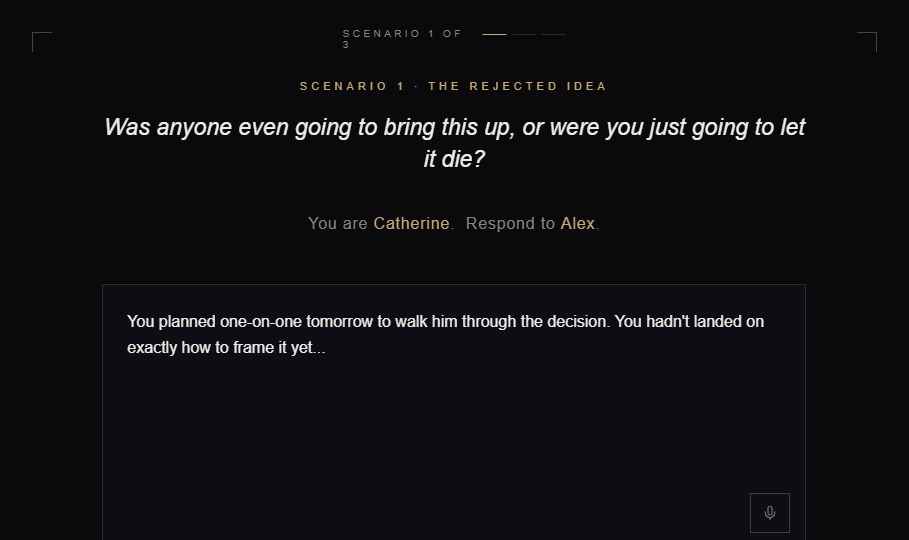
Hard Conversations is three workplace scenarios. In each one a manager has to deliver news nobody wants: a proposal killed after six weeks of work, a lead taking the blame for a team’s mistakes, a promotion that went to someone else. You watch the conversation unfold between two people until it reaches the breaking point. Then the employee turns to the camera and says the hard part directly to you. The scene stops. You’re not watching the conversation anymore. You’re in it, and it’s your turn to speak.
You type or you talk. Your words go to an AI grader that evaluates them against four things that decide whether a hard conversation works: directness, acknowledgment, specificity, and whether you left the other person somewhere to go. Each rates strong, partial, or missing, with an explanation that quotes your own words back to you.
After the third scenario, it reads across all three responses for the pattern in how you handle pressure, writes a personal summary, and delivers it as a short generated video.
None of it is templated. Every grade is computed live, every summary is written live, and no two people get the same video back.
Where Else This Works
Finding the right words under pressure.
The scenarios here are difficult management conversations, but the technique isn’t tied to them. It fits any moment where someone has to find the right words under pressure, and where the words they actually choose are the thing that matters. That covers a lot of ground most training never touches:
- Speaking up to someone senior. A team member spots a problem, a risk, a shortcut being taken, and the person they have to tell is the one who outranks them and is already brushing it off.
- Owning a mistake to the person it affected. Not the incident report. The conversation, with the person looking at you, where what you say first determines whether trust survives.
- De-escalating someone who is past listening. An angry customer, a frightened family member, a colleague at the end of their rope. The script you memorized dies in the first ten seconds.
- Answering the question you didn’t get to prepare for. An auditor, an inspector, an executive stops at your station and asks why. You know the material. Can you say it, right now, in your own words?
- Coaching after something went wrong. Correcting the behavior without flattening the person, specifically enough that it changes what they do next time.
Same structure every time: real footage draws you in, the moment turns to you, you answer in your own words, and the grading measures what you said against what that moment demands. The scenarios, the people, the pressure, and the rubric all rebuild around whatever conversation your organization actually needs people to get right.
Live Interactive demo
The next words are yours.
Three workplace conversations. Speak or type what you would actually say, then get live feedback on how you handled the pressure.
- Three scenarios
- No form
- Starts immediately
Your answers are evaluated live against the conversation, not a multiple-choice key.